Have you ever found something special hidden in the sand? Maybe a precious shell or a piece of jewellery left behind? You may have been pretty chuffed, but not as much as the archaeologist who started digging in the sand a few kilometres from here and probably couldn’t believe it when he uncovered a whole city buried in the sand dunes!
I think you can have too much of a good thing and walking round ancient ruins might not be everyone’s cup of tea…but despite recent trips to a ruined castle and a ruined abbey with our latest guests, yesterday we decided we couldn’t put off a visit to the ruined city of Salamis any longer. Arriving in the afternoon the sun was still beating down and with the sea at our backs looking an inviting blue, it was on with the sun cream and hats, bottles of water at the ready and we were all set to go ‘time travelling’…
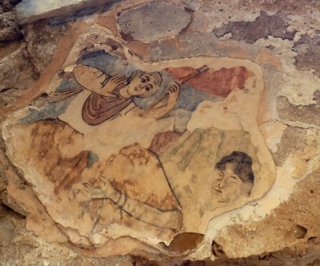
Wisely, the help of a local guide was enlisted for half an hour and she was, as one person said, “worth her weight in gold”, even if comments were made about quite how much that might add up to, since she was not a small person. Like every great storyteller she immediately began painting pictures from the past of life in 300AD under the Romans or Byzantines as they later became. Her tales of naked bathing and gym sessions and eaves-dropping by the slaves in shared toilets ‘with a view’ brought to life the crumbling walls, alcoves and pillars as we trailed around the site. We could almost hear the rich young men splashing in the shallow baths, heated by hot air and special heat-holding bricks from beneath. Although the stone was now rough and worn in places we could still see the slabs and traces of the white marble that would have covered most surfaces. As I glanced up at a wall and columns towering above us and envisaged them coated in shimmering marble, I shivered to think how incredible the city would have looked in the sunlight. In many areas the beautifully coloured mosaics were still visible and intact and I have to confess we walked across them, as if they were tiles in our own hall. There were so many gems, like the remains of a fresco in an archway above our heads, the colours still strong with powder blue, greens and deep reds. We could see pomegranates and leaves depicted in mosaics and in other places more mosaics and areas that were still tiled with the original colours of black, white, red, orange and blues. There were constant sighs of ‘incredible’ and ‘come and see this’, as we wandered in amongst a network of rooms and half crumbled buildings.
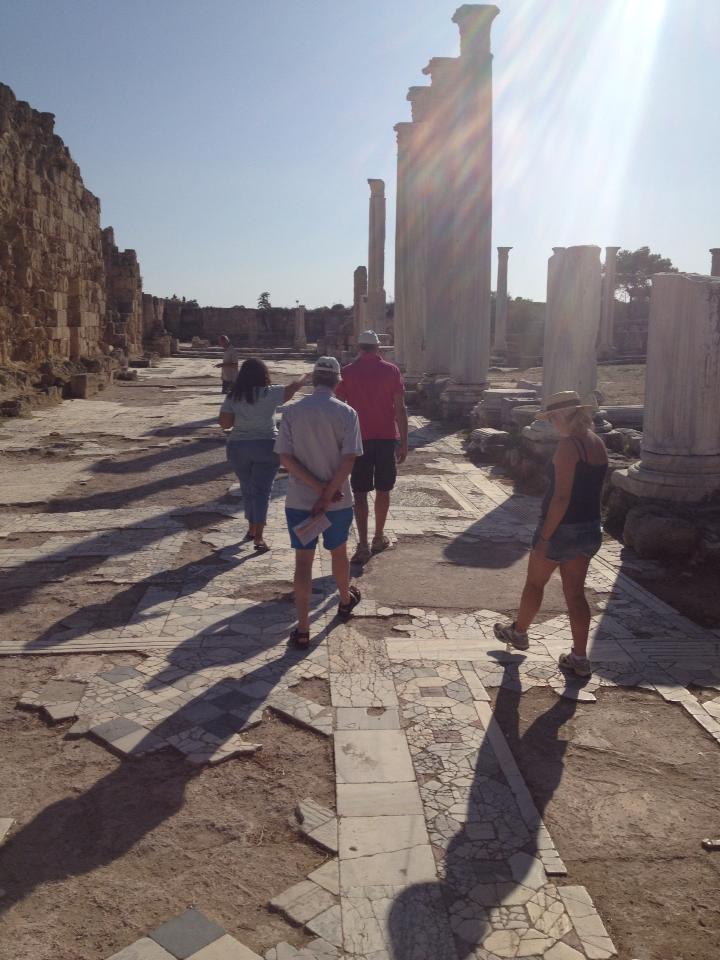
Surprisingly, I have never been so informed about the origins of English words and phrases as I was yesterday, because our guide was a fount of information. For example, the low level semi circular area in one building housed a communal toilet, which looked across the gymnasium and exercise area where naked male wrestling was the top show. We gradually realised it was a pretty clean one all in marble with fresh water running continuously through it, unlike the rough dusty sandstone blocks above the drain that were all that was left today. Apparently people would sit here and rather than read a newspaper or a book privately, as you do, they would chat to each other and watch the wrestling! I didn’t spot any old stone toilet roll holders that’s because they used sponges on sticks instead…not a pleasant thought. Meanwhile, the slaves left outside the wall behind these toilets would listen in to private conversations in order to gain information and use this to bribe people later. It was this practice that led to the phrase: ‘the walls have ears’. So, phone hacking and listening in is nothing new, it was just a little less techie in those days, but just as dangerous. Further on in the site we saw the partly excavated amphitheatre which we expected to be semi-circular. No, explained the guide the word amphitheatre means two halves of a circle coming together, to either form a circle or an elongated circle. The semi-circular buildings with seats and chairs are technically called ‘theatres’…and she noted with a smile that it was amazing how many universities use the wrong word for their buildings, calling them amphitheatres when they are actually theatres.
We all became a bit blasé about the mosaics… saying, “I’ve found some more here!” behind another little low wall in a basilica, while everyone just nodded. The site was quite extensive and I believe the largest on the island. It included several acres spreading down the coastline with temples, forums, roads, baths, villas, a stadium, various basilicas or churches, a theatre and of course a gym. At one basilica we were searching for a special tomb, as our guide had given up on us by then, and I felt sure I had found a stone shaped hole the right size for a body – not everyone was convinced, as there were quite a lot of stones and holes for that matter! The afternoon included plenty of leaping between low walls and then nearly falling off them when a pair of giant lizards, or ‘Leonards’ as we call them, startled me. The guide had told us to be careful of snakes and we all held our breath slightly when one inquisitive member of the party decided to try and squeeze under a low roof at the bottom of some steps leading into a very dark cellar which would have made a good setting for an Indiana Jones sequel. “Be careful,” said the guide, “You may find someone else in there….it’s a good place for snakes.” After that I kept hissing quietly round corners and stamping my trainers heavily in order to warn any basking snakes I was armed and dangerous.
It was quite amazing to think that this was the place where St Paul landed on his very first missionary trip and that he had walked on these same mosaics and probably lent against a few of these actual pillars. In the forum there was a very lonely column with some fine leaf carvings that towered against the skyline and it seemed a little sad that this was all that was left from this immense building, part of a once bustling, cosmopolitan city. Although Salamis is just a ruin now, partly destroyed by two earthquakes, the last one did so much damage it was abandoned. But some of the inhabitants went to a nearby fishing village where they re-built their homes, palaces and churches with much of the rubble and stone from the broken buildings. The name they gave the city, now known as Famagusta, was ‘Ammochostos’, which in Greek means ‘hidden in the sand’. A fitting tribute to Salamis – the city they had left behind.
We eventually decided we were ‘ruined-out’ but I think I’ll be going back, if only to keep those snakes and lizards on their toes. But next time you start digging in the sand dunes remember that you never know what lies beneath…you may find another Salamis.